Search the evidence

Find the signal.

Search titles, impact clusters, countries, organizations and the full text of every analysis.

2 stories found

Work & marketsUnited States+3 clusters01

Federal Reserve Governor Michael Barr, “Will Artificial Intelligence Broadly Raise Living Standards or Drive Income and Wealth Inequality?”

Barr presents competing AI-distribution scenarios: broad augmentation could disproportionately improve the productivity of less-experienced workers and expand access to expertise, while labor substitution, unequal access to advanced models, and concentration of compute, data, and model-development capacity could deepen income and wealth inequality. He notes little evidence of economy-wide AI displacement so far, alongside early indications that entry-level opportunities may be weakening in some occupations and a substantial education gap in AI use—43% of workers with graduate degrees versus 10% with a high-school education or less in the Fed’s latest household survey.
2 min
Work & marketsUnited States+3 clusters02

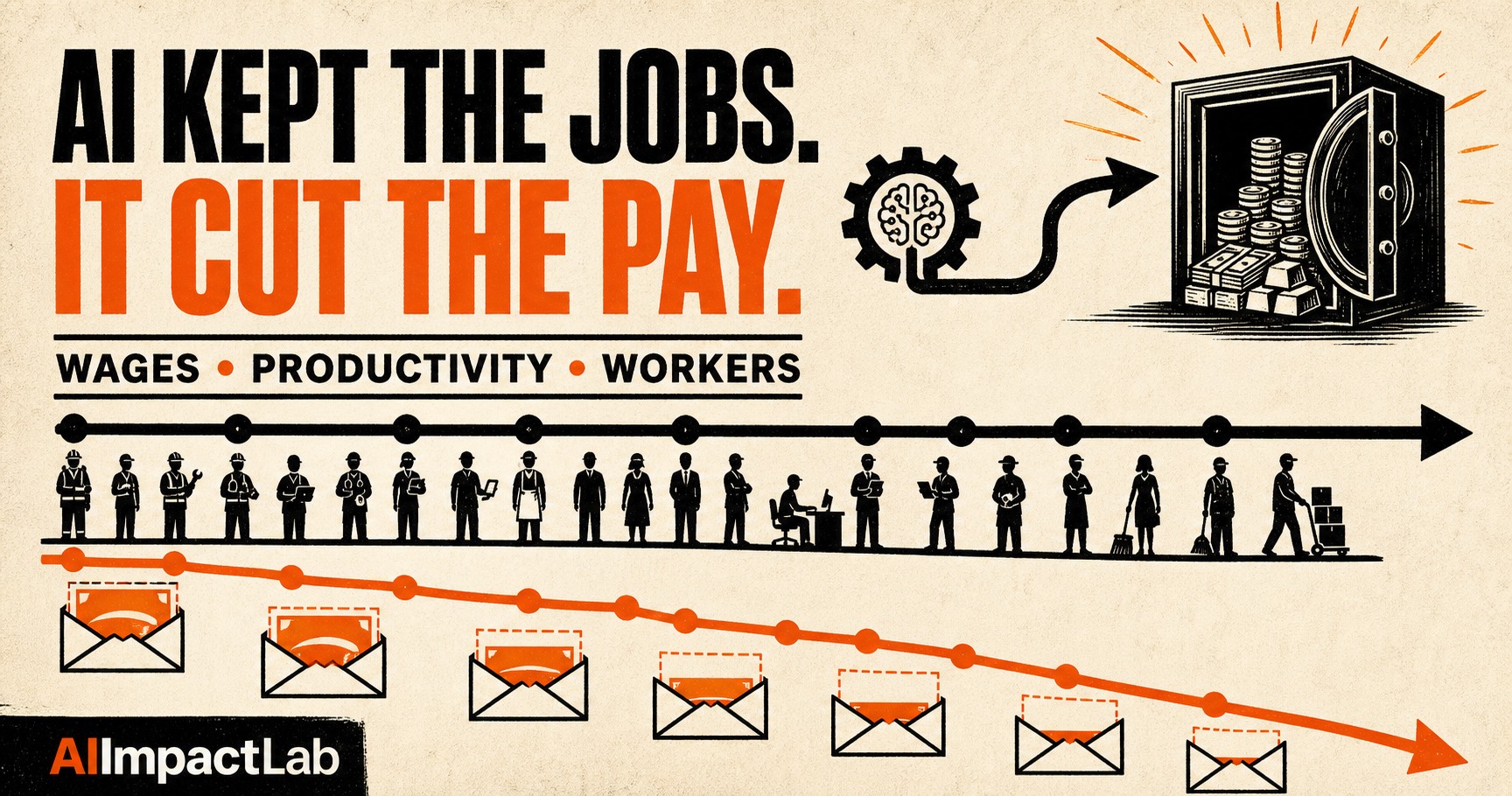
AI may be cutting pay before it cuts jobs

A new study of the United States labor market finds that occupations with high observed AI use experienced 6.7 percentage points slower real-wage growth after 2023, while their overall employment showed no statistically detectable change. The analysis matches Bureau of Labor Statistics data from 2015–2025 with observed Claude usage across 321 occupations. The effect was concentrated lower in the wage distribution: the bottom quartile saw a 10.7% relative decline in wage growth, while the top quartile showed no significant effect. The result challenges the idea that stable headcount means workers are unharmed; employers may capture early productivity gains through wage compression before aggregate job losses appear.

4 min